Shampoo, Property Rights, and Civilization (with Anthony Gill)
Intro. [Recording date: September 17, 2025.]
Russ Roberts: Today is September 17th, 2025, and my guest is Political Scientist Anthony Gill of the University of Washington. This is Tony’s third appearance on the program. He was last here in November of 2017, talking about tipping.
Our topic for today is shampoo, something I really have no interest in. But, actually, we’re going to talk about something much deeper and profound, and I am pretty sure you, the listeners, will find it as interesting as I did when I read an essay of Tony’s in the Library of Economics and Liberty, which hosts EconTalk; and we will put that essay up online.
Tony, welcome back to EconTalk.
Anthony Gill: Thanks. Glad to be here. And, I love shampoo. I used it this morning.
Russ Roberts: Who knew?
Russ Roberts: So, you open your essay with a very simple question, and it seems to have a very simple answer, and you suggest that simple answer is wrong. The question is: Who or what enforces property rights–in America, say? And, what’s the simple answer?
Anthony Gill: Well, the answer is obvious: It’s the government, because the government writes these rules; these rules are put into books. The books are put into the deep recesses of libraries, and everybody can go see the rules of these property rights. That’s obvious. When I ask that of my students, they automatically turn to the answer: The government defines property rights.
Russ Roberts: Well, and they have police, courts.
Anthony Gill: Yeah, yeah.
Russ Roberts: They enforce the property rights. It seems true.
Anthony Gill: Yeah, it seems very obvious. I actually have an exercise: I have my students–I strand them on a deserted island, a very typical trope within economics–have them build a society. And, I say, ‘Who is going to determine who gets to use what?’ And, their answer is, ‘Well, it’s the government.’ And, I have to ask them, ‘Well, who is the government, and how do we decide on how the government is? How do we decide how to decide?’
And, then, I also pause and ask them, I go, ‘Well, it’s obvious that the government defines property rights. So, when was the last time that you read the rules? You went to the Federal Register here in the United States, or to our regulatory codes in the state of Washington? When was the last time you read those and knew those?’ Nobody, nobody reads these things.
Russ Roberts: Never.
Anthony Gill: No. So, that’s the wrong answer. Well, it’s not–I shouldn’t say entirely the wrong answer. The government does define property rights, and it will take time to monitor, enforce them in certain circumstances. But, for the most part, it’s not the right answer.
Russ Roberts: And, in a huge portion of circumstances–and we talk about this a lot on this program–there are what we might call unwritten rules, norms, and other things that determine who can do what with what. And somehow, that brings us to shampoo. Which, by the way, I also used today. And, my children mock me: I shampoo twice. So I do rinse and repeat. They think I’m a victim of the shampoo industry, but I like the way it feels after two shampoos. So, what does this have to do with shampoo?
Anthony Gill: Yeah. Well, first of all, you should lather, rinse, and repeat because that’s what the rule says there on the bottle, right? You don’t want to be violating any kind of rules here.
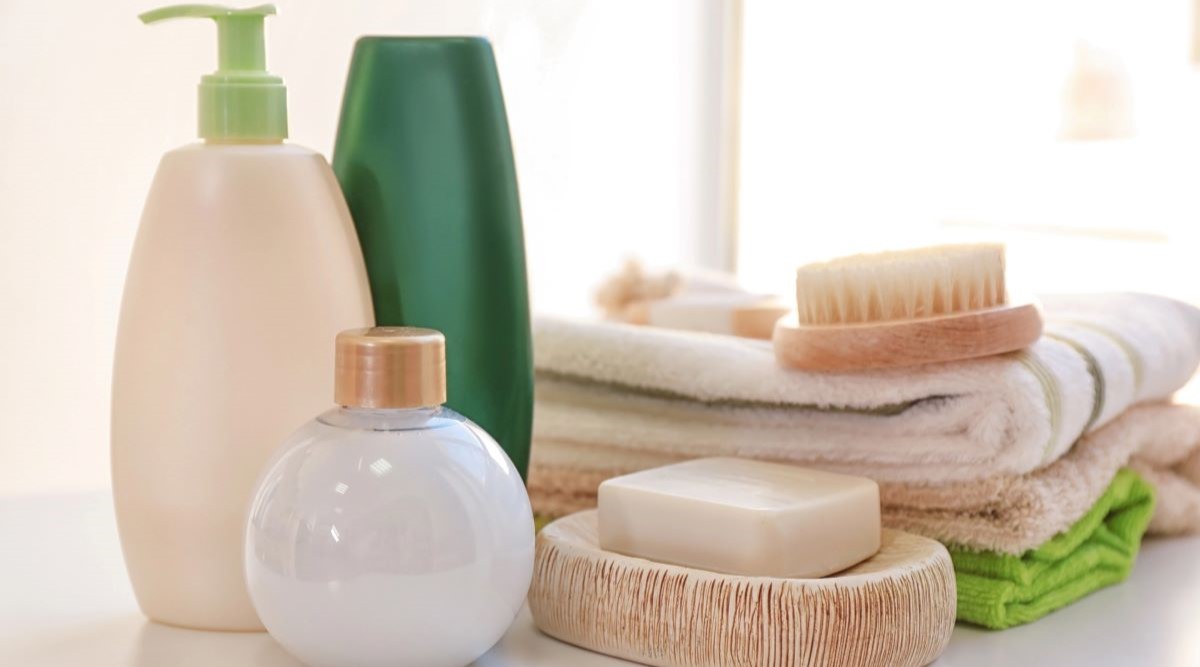
So, well, this is a little puzzle that has flummoxed me for a long time, and we can maybe talk a little bit later about why this puzzle started to eat at me and why it became an issue. But, I know many people go to hotels all around the world, and if you’ve been traveling for several decades, you’ll know that a lot of hotels provide you with these small, personal-use shampoo bottles. Conditioners; sometimes in the fancy restaurants, they have mouthwash. I love those things. I absolutely love them. I love them so much that I actually have a whole bin–and this is just one bin–of these little shampoo bottles. And, for those of you listening, I just held up a rather heavy bin of these little, tiny shampoo bottles. Absolutely fascinated by them.
However, it was a few years ago–maybe five, six, seven years ago–especially when I traveled out in California, that I noticed that hotels were not doing this anymore. They put dispensers on the wall. So, it was a large bottle; sometimes it was directly connected to the wall, sometimes they just put it on the ledge, they had a large bottle there. And, this irritated me because I love collecting these little bottles and taking them home. I use them on a regular basis. I don’t think I’ll ever have to buy shampoo for the rest of my life.
And it started–I had this kind of question here.
And, I was recently at the Stephenson Institute at Wabash University. I had stayed at the Liberty Fund a few nights before, and they had a hotel, or they put me in a hotel that had a dispenser on the wall. But, when I went to Stephenson Institute, they had little bottles. And so, I’m sitting there in the hotel room thinking about this, and I said, ‘Well, wait a minute. If I’m allowed to take these little shampoo bottles home,’–and, everybody knows that. I ask people, ‘Can I take these little shampoo bottles home?’ They go, ‘Of course you can.’ Everybody knows you can.
Russ Roberts: I just want to put in a footnote. You take them home sometimes, Tony, I’m going to guess, even when you haven’t opened them. So, if you opened one and you shampooed once or twice and now it’s a third empty, you would feel really okay with taking it home because they’re not going to leave it for another customer; so you take it home.
But, the next step–which, you know, you may be a felon, this is a dangerous conversation–the next step is to say, ‘Well, I brought my own.’ As it turned out. And so, it’s there implicitly–and that word is very important ‘implicitly’–it’s included in the price of the hotel. It’s free. In fact, more than it’s free, I paid for it, it’s not free. It’s built into the price, with a bunch of other amenities in the room. The towels I get to use, the sheets I get to use, and so on.
And so, it’s totally okay to take a full, unopened little, tiny bottle of shampoo because it’s included as a gift to me as the customer. In fact, many hotels say, instead, for the other range of things particularly: ‘If you forgot fill-in-the-blank, we have some available for you.’ So, toothpaste, other things, dental floss. Who knows? A toothbrush. You could buy one from them; they might give it to you as a way of showing you, making the customer experience more pleasant.
But, your point here is that you haven’t opened it. It’s sitting there in the little basket, and you, as you’re putting away your toiletries and packing up to leave, of course you put that in your bag because it’s considered part of my–it’s mine.
Anthony Gill: Yeah. And, I go through many rationalizations on this, too. It’s like food, like crackers at a restaurant. It’s that once they put them on the table, they’re contaminated, and they have to throw them out anyway, so I might as well take it home and use it.
I don’t know if that’s true or not, but it certainly is a good rationalization.
And I maybe should not admit this, but it’s even more addictive for me that at conferences, I will seek out the bald people and ask them, ‘Hey, you’re not using your shampoo. Would you mind bringing them down for me?’ So, somebody would think that’s horrible.
Russ Roberts: It’s pretty horrible.
Anthony Gill: And, that’s the reaction I got. I raised this question to–we were at a small conference at Wabash, and the next question that I raised to them I think horrified them. The first thing is that we can take these little shampoo bottles home, right? They said, ‘Oh, of course, everybody knows that, everybody knows that.’ I go, ‘Well, can I take the large dispenser bottles home with me?’ And, they were horrified. They said, ‘Well, of course you can’t. No.’
You know, there might be one reason: The bigger bottles are 16 ounces, and you can’t get through TSA [Transportation Security Administration]. I said, ‘Well, I’ll check my bag. I’ll just put it underneath the thing so I can take that bottle home.’ But, they were horrified. They said, ‘No, no, no, you can’t do that.’ I go, ‘Why not? Why can’t you do that?’ Because, what’s the difference between–this is what, three ounces or so–and the 12-ounce bottle? It’s just shampoo, right?
Russ Roberts: The better example you give in your essay is: Can’t I just bring an empty one and fill it from the dispenser, since I didn’t use my share?
Anthony Gill: That is correct.
Russ Roberts: I’m entitled to three ounces, and I might not have used it all, so I can fill my empty bottle that I brought from home. I assume that would horrify them, too.
Russ Roberts: Yeah.
Anthony Gill: And, I do that. Because, I am so addicted to these little shampoo bottles. I love containers–any kind of containers, right? So I admit I have a problem there. I will bring empty bottles, and if I know it’s going to be a certain hotel brand that did go to the dispensers, and I will fill it up. Especially if I like the shampoo: there are some hotels that I really like the shampoo. Other ones, not so much.
And people are shocked by this. They’re like, ‘Oh, my gosh, how can you do this?’ Well, I consider this–since these hotels started introducing these small bottles some 50 years ago or so–I consider it a right that whenever I pay the price of a hotel room, I should get at least three ounces of shampoo and conditioner. So, they were horrified. Who would do that?
Now, that horror–the horror, I guess, would be bemused horror. I wasn’t ostracized, but it was this bemused horror. But, it’s going to become important a little bit later, in terms of enforcement of property rights. But, yeah, that’s a good question. What’s wrong with me taking three ounces of shampoo from the dispenser and putting it into the small bottle?
Russ Roberts: Or two or three small bottles.
Anthony Gill: Well, I’m going to stop and plead the Fifth Amendment right there.
Russ Roberts: Okay. It reminds me of–I think it’s the first Marx Brothers movie–The Cocoanuts, which is pretty good. It hasn’t reached the level of their later masterpieces. But, in The Cocoanuts, I think Harpo and Chico check into the hotel, and they’re bringing their suitcases, and they run into somebody, and the suitcases spill open. And, the porter says, ‘These suitcases are empty!’ And, Harpo or Chico says–well, it would be Chico. Chico says, ‘Well, they won’t be when we leave.’
Because, in those days, there was a thing about towels. You could kind of, sort of, not literally take a towel. It wasn’t really okay: it was stealing. But, the enforcement mechanism isn’t perfect. And, I would think–I’ve never stolen a towel in my life; I’m going on record here. But, I wonder, would they really enforce it? A bathrobe, yes. They make it very clear that if you want a bathrobe that they’ve hung up, that you can buy it; they give you a price, so it’s clear that it’s not included.
But, it’s a fascinating question of–that property right is sort of enforced by something else. And, most of us–maybe not you, Tony, I’m learning more about you by the minute–most of us would say, ‘It’s wrong to put the towel in my suitcase, even though I can.’ And, maybe people would say, ‘It’s wrong to put the dispenser of shampoo in my suitcase, even though I maybe can.’ I’m not sure if they’d call you and say, ‘Hey, we noticed that was missing.’ But, they’re certainly not going to call you for excess shampoo use because you filled up an extra three-ouncer out of their wall dispenser.
Anthony Gill: Right. And, it’s not only that. I probed people more on this. Because, it started to get a conversation going. This was an early morning breakfast; people were still a little bit sleepy, and I started perking up people. When I asked, ‘Can I take the 12-ounce dispenser bottle?’ there was a rather esteemed political economist there who said, ‘No, you can’t. It’s illegal.’ And, I said, ‘Well, show me the law.’
Russ Roberts: Yeah, where’s that?
Anthony Gill: Show me the law that says, ‘Thou shalt not take the 12-ounce bottle of shampoo.’ And again, it’s interesting to note that, because the fact that this person said it’s against the law immediately told me, ‘Ah. This person defaults to the government setting property rights.’
And I entirely acknowledge: yes, stealing is wrong. In fact, you go to the Ten Commandments, ‘Thou shalt not steal.’ Okay, now there’s codes in our government rule books that said this is a robbery, this is a burglary, this is a felony offense, this is a misdemeanor, etc., etc. But, I don’t think there’s one specifically related to 16-ounce bottles of shampoo.
And again, what’s the difference between three ounces and 16 ounces? Where does that line draw? If it was a five-ounce bottle, is it okay? If it’s 10 ounces? Where does this line get drawn? And, I think that was really kind of the interesting question that got a lot of people to start thinking about: Yeah, how do we define what’s stealing, and therefore, how do we define what’s property rights? Is it really the government that does that?
Russ Roberts: And we’re going to get to the answer in just a second. I just want to add one more example, which I think about a lot, and I think it applies to a lot of different things.
So, all retail establishments–and hotels would be an example of a particular kind of retail establishment–they all have to deal with shoplifting, which is a fancy word for stealing. It means stealing that’s not from another person’s personal property, but from a corporation’s or an institution’s property. And, we all understand that the prices we pay include a premium for shoplifting. Shoplifting is priced into the prices in every store we’re in. There’s some amount that is tolerated because it’s too expensive to monitor it perfectly. And so a store, to stay in business, has built into its pricing the understanding that some things will walk away.
And I assume, in the old days, when people were poor and towels were more scarce and more expensive, people did steal towels from hotels more often, and the price of a room had to include implicitly a possibility that you would steal the towel.
Or worse is the example that you give in the essay: a mattress. Now, as you point out, it’s hard to steal a mattress in a quiet fashion.
But, this leads many economics students to what I think is an immoral conclusion–and I don’t know if you’re going to agree with this, Tony. They will say, ‘Well, since I’m paying for the shoplifting in the price, I’m entitled to take some things for myself without paying for them because I’m already paying for them when I buy stuff.’ So, similarly, the argument could be, ‘Since some towels get stolen, and therefore, the price is higher for the hotel room, I’m entitled to take a towel with me now and then because I’m paying for it.’ What’s your thoughts on that?
Anthony Gill: Yeah, that becomes a slippery slope for me.
Russ Roberts: Isn’t it?
Anthony Gill: I love that rationalization for being able to take 16-ounce bottles of shampoo home. And even a mattress. The mattress example that I give in the article was forwarded by the person who says, ‘Well, there’s a law against stealing the hotel stuff: you can’t take a mattress.’ And, my initial response stuff was, ‘Of course I’m not going to steal the mattress. It doesn’t fit into my carry-on.’
Russ Roberts: Yeah.
Anthony Gill: Right? So, it’s not practical for me to do that. And the person at the front desk is going to notice when you’re carrying a very large mattress or a television set out the front door of the hotel.
So, what you just said is, ‘Oh, I’m entitled to do that.’ So, ‘Everybody else is doing it. It’s built into the price, so why don’t I just do that?’
I actually don’t go that far. So, you are learning more about me, and so far you may have been a little bit horrified–bemusedly horrified–that I take bottles and fill them up with shampoo. But I am not such a felon that I go all the way to taking mattresses, or even the full 16-ounce bottles of shampoo. So, rest assured that I don’t do that.
There’s something there that’s stopping me. Right? And, this is really, I think, interesting. It connects to a lot of things that you’re interested in, too, mainly Adam Smith’s The Theory of Moral Sentiments. Where I know I’m in the hotel room, I could take a bunch of stuff, nobody’s going to find out. But, I don’t do it anyway; there’s something there stopping me. Right? There’s a self-monitoring aspect to all of this.
And I want to give one more example in the hotel room that just really horrified individuals, because it’s actually quite important here.
Russ Roberts: Yeah.
Anthony Gill: We were talking about shampoos; the conversation turned to mattresses. But, I said, ‘Well, what about toilet paper?’
Russ Roberts: Great example.
Anthony Gill: You’re halfway through a roll of toilet paper. And, why can’t I take that home? That fits into my carry-on suitcase. And, again, everybody was shocked. Like, ‘Who would ever think of doing that? That is the most horrifying thing.’ And, I reminded them that during the pandemic in 2020, early on, toilet paper was at a premium. So, if you were traveling out somewhere, why not take an additional half a roll? It’s basically the same cost as a small bottle. But, there was just an abject horror that anybody would ever think of doing that. So I don’t do that. I’m not going to take–yeah.
Russ Roberts: I just want to add that when people say you’re allowed to shoplift–or, there’s a gray area which I didn’t mention, which is grapes. In Italy–I was just in Italy–they don’t let you touch the fruit. You can’t pick up a nectarine and give it a little squeeze to see how fresh or ripe it is. You can’t touch the grapes. You can’t ‘squeeze the Charmin,’ if I may use a bad example. Here in Israel, you can touch it all you want, and you’re expected–you’re kind of allowed–to taste the grapes. Of course. You can’t take a peach and take a bite out of it and say, ‘This seems like good, it is going to be ripe.’ But, one grape, it’s understood that that’s okay.
And, that leads to a question, which is related to our ounces of shampoo. Well, if one is okay–a second would be probably okay, too, just to make sure. But 12 would be too many. And probably four would be too many.
And the question then is, why? And, how is it that we have an aversion to the sixth grape, or the toilet paper roll, or the towel, when, as you say, there’s no legislative piece of document that’s keeping us from doing this? Something else is doing that.
And the last thing I want to add is: this is Kant’s categorical imperative. If everybody ate 12 grapes because you can–because they don’t monitor it–grapes would be very expensive. Because, the premium they’d have to charge for the people tasting and sampling and enjoying them would have to be priced into the fruit. And, we don’t want to live in that world. We don’t want to live in a world where we have to pay an extra premium and then feel I am entitled to my share.
So, what certain moral codes do, at least ideally, is to self-monitor us and make us realize that that is not a world that would be a good world.
And the other way I think about it is, if you ask the owner of the store, ‘Can I have a grape?’ he’ll say, ‘Oh, yeah.’ In Israel, Not in Italy. In Italy, he’ll give you a horrible look if you get near the grape with your hands. But, if you ask the guy in Israel, ‘Can I have a grape?’ or in most American stores, they’ll say, ‘Sure.’
Can I have a cluster? No.
So, there is a gray line that’s not drawn, but it’s clear that the grapes aren’t really free to sample. They’re free to taste one; that’s the implicit deal that’s on the table. And, the question you raise, I think, in your piece–which is beautiful–is, where does that come from? Where does that come from?
Anthony Gill: I want to point out something that you just did when you were talking about the categorical imperative. You acted very much like a good economist. You thought, ‘Well, if everybody takes a number of grapes, then the price of grapes gets too high, and we don’t want a high price of grapes.’ So, you did the whole cost-benefit calculation there, and that was wonderful. That’s the great economic answer that I have my students think about when we think about collective action problems and free riding, and the tragedy of the commons. But, is that really the thought process that you go through? Why am I not taking all these grapes, or a handful of grapes? I think the answer comes down to: Because my mother told me not to do that when I was three years old, or five years old, and it was reinforced there. So, it was something that–not that there’s a calculation that we go through–
Russ Roberts: Fair enough–
Anthony Gill: Maybe somebody did that calculation, but it’s just you were drilled from Day One, ‘Don’t take a handful of grapes. Don’t steal. Thou shalt not steal.’
And, it comes in a lot of different forms, right? You kind of learn. It’s: Well, you don’t take three or four grapes, but you also don’t take somebody else’s toy when they’re playing with it, or something like that. And, those things are what help to monitor us, but it also creates a certain [milieux? inaudible 00:23:15] that says, ‘In our society, it is not proper to do these things, and if you want to be seen as a propitious person–somebody who is concerned about propriety–then you should not be taking these things.’
And that starts to act as this internal brake upon us. It helps us to self-monitor, with the assistance of civil society reminding us constantly, ever since we were children, that this is how a proper person behaves.
Russ Roberts: Yeah. I should have explained a little bit. The categorical imperative of Kant is, if you’re deciding whether to do something, you should ask: ‘Well, what if everyone acted this way?’
And, if you don’t like the answer to that, you would realize that it’s not a good thing to do.
And, I agree with you–I don’t think people say, ‘Oh, when I invoke the categorical imperative.’ What they actually do is, they have certain norms that come from parenting, school, church–you name it–where they’re told what is right and wrong.
And those norms come from somewhere. That’s what’s fascinating. And they differ by society–Italy and Israel–and fruit being an example, right? In some societies, it’s okay to take more than one grape, and in some, you’re not allowed to take any. I hope I’m not being unfair to Italy. I was in, I think, at least two Italian cities this summer where both times I was told not to touch the fruit and was glared at.
But, those norms–those norms–there are two issues: Where do they come from, and what enforces them? They are two separate questions.
Anthony Gill: And, if you want me to answer that question, I’m going to shrug my shoulders and say, ‘I’m not really so sure about that.’
As for where they come from? Boy, those questions get really murky. Our last episode that we recorded together many years ago on tipping, the question comes up, ‘Well, who started tipping?’ And, as far as we can know, it was sometime in the 16th century in Britain, but it’s really murky. These are things that just kind of emerge.
So, we talk about how prices affect economic allocation, and you get this emergent order that Hayek always talks about. But, these things happen, too, not only with prices and the allocation of resources, but with rules.
So, rules somehow emerge from there as well, and Hayek has written some really great stuff on this in Law, Legislation, and Liberty about the evolution of norms. And, we could talk about the evolution of norms, but where they come from, oh, boy, that’s really hard to know because they just kind of evolve. How do they work–?
Russ Roberts: But, I would suggest they evolve in trial and error and all kinds of complex ways. But, they stick because they work.
Russ Roberts: And, there’s more than one norm that can work. And, I think the most important thing is that there is a norm in many situations. There’s an expectation of what is appropriate behavior. If it’s six ounces of shampoo, that’s okay. If it’s three ounces, that’s okay. And if it’s zero, that’s okay. But, once you know the norm–so, if hotels don’t provide shampoo–which is, I’m sure, the way it was in the 16th century in England, while we’re on the subject. You walked into an inn in the Cotswolds, and you didn’t ask for the shampoo, you brought it. There wasn’t anybody in the world, but if you wanted to use a product, you brought it with you. And, because we got wealthier as a society and the world got wealthier, hotels could relatively inexpensively make sure that you didn’t have to worry about it.
And that’s why it persisted. That’s why that norm came to be for those precious decades, Tony, in the 1970s, and 1980s, and 1990s, when you got the little bottles. That was the norm. You went to the hotel; you didn’t bring your own shampoo because you knew the hotel would have it for you. So, that was convenient and that was nice. But, if people start taking them like you, eventually they went to the wall dispenser because they realized that not everybody really needs it each time, and some people don’t use the whole bottle, and they’re only there for one–etc., etc. So, they found it less expensive to give you the wall dispenser, which is really for the customer.
This is the most crazy part of these kinds of norms that emerge, because it was really expensive. If everybody filled their empty bottles–brought them with them, and emptied the wall dispenser–they’d stop doing it because I wouldn’t want to stay at the hotel anymore, because the price would have to be so high to cover the cost of the wall dispenser being emptied, and the towels being used, and the TV being tucked under your arm when you left. So, in a dishonest society, where norms are ignored or the norms are awful, certain things don’t get provided. I might not even get a hotel room because people would pull up the rug and take the mattress. It sounds like a ludicrous comedy, but that’s really a possibility. There are many things in a society without trust, where norms are unobserved–not observed by the people–you can’t have certain products.
Anthony Gill: And that’s a really important observation here that goes to the larger picture of what I was trying to get at–is that: If we just rely upon the government to define property rights, to monitor them, and to enforce them, we have a problem because the government can’t do that all the time. There are so many different opportunities where we go unmonitored, and we could get away with everything. So we need a strong civic society–a strong sense of trust and honesty within society–to make the economy work. It’s very, very important in those kinds of things.
Again, to go back to your question: Where does this come from, and how does it evolve? It’s a very interesting and mysterious question. To think about the issue of shampoo–and you got me thinking now that I’m a norm entrepreneur by telling people to take small bottles and fill them in a dispenser. Now I feel like I’m undermining Western civilization somehow.
Russ Roberts: Yeah, you are. Yeah.
Anthony Gill: If nobody can get a hotel room anymore because the price went up because Gill convinced everybody to swipe the shampoo, I’m going to feel a little bit horrible about that.
I don’t think that will happen. [More to come, 30:14]



Post Comment